
A remote work policy explains who may work remotely, where they may work, how availability and performance will be handled, which security rules apply, and what support the employer provides. The best policies are specific enough to prevent arguments but flexible enough to work across roles and locations.
The template below is a practical starting point, not legal advice. Employment, tax, expense-reimbursement, privacy, and leave rules vary by jurisdiction. Have counsel review the final policy wherever employees work.
What a remote work policy should cover
Before drafting, settle ten decisions. Define eligibility and the approval owner. Name the states, countries, and physical locations where work is allowed. Set core hours, time-zone expectations, breaks, and overtime approval. Explain response times and required meetings. State the outcomes or service levels used to review performance.
Then cover the operating details: who provides and supports equipment; which devices, networks, storage, and incident rules apply; what expenses are reimbursed; what monitoring data is collected and why; and how the arrangement may be reviewed, suspended, or ended. If one of these decisions is still unresolved, mark it for review rather than hiding the gap in vague policy language.
Copy-ready remote work policy template
1. Purpose
This policy establishes expectations for employees who work away from a company office on a full-time, hybrid, temporary, or occasional basis. Remote work is a work arrangement, not a change to job duties, performance standards, compensation, or applicable company policies unless confirmed in writing.
2. Eligibility and approval
Remote work may be approved when job duties can be performed effectively away from the office and the arrangement is compatible with team, customer, security, and legal requirements. Approval is based on the role and business need, not as a guarantee for every employee in a similar title.
Employees must receive written approval from [manager/HR] before beginning a recurring remote arrangement. The company may use a [30/60/90]-day trial period.
3. Approved work location
Employees may work only from locations approved by the company. A move to another state or country, or an extended period working elsewhere, requires advance written approval because it may create payroll, tax, immigration, insurance, or employment-law obligations.
The workspace must provide reasonable privacy, safety, internet reliability, and protection for company information.
4. Work schedule and timekeeping
Employees are expected to work their agreed schedule and be available during [core hours and time zone]. Nonexempt employees must record all hours worked, take required breaks, and obtain approval before working overtime or outside the agreed schedule.
Employees must not perform unrecorded work. The U.S. Department of Labor’s recordkeeping guidance explains the federal records employers generally must maintain; state requirements may add to those obligations.
5. Communication
Employees should keep their calendar and status reasonably current, attend required meetings, and use the approved communication channels for urgent and non-urgent work. Teams should state expected response windows rather than treating every message as immediate.
6. Performance
Performance will be assessed using the same job-related outcomes, quality standards, deadlines, and conduct expectations that apply to comparable on-site work. Online presence or message volume is not, by itself, a performance measure.
Managers will review the arrangement [monthly/quarterly] and address workload, communication, delivery, and support needs.
7. Equipment and support
The company will provide: [laptop, monitor, security software, peripherals, support].
The employee is responsible for: [internet service, appropriate workspace, reasonable care of equipment].
Company equipment must be used and returned according to the equipment policy. Personal devices may be used only if expressly approved and protected under company security requirements.
8. Information security
Employees must:
use company-approved devices, accounts, and storage;
follow multi-factor authentication and password requirements;
connect through an approved VPN when required;
avoid public or shared computers;
protect screens and conversations from unauthorized people;
report loss, theft, suspicious access, or accidental disclosure immediately;
follow rules for printing and disposing of company information.
9. Expenses
The company will reimburse approved business expenses in accordance with applicable law and the expense policy. Employees should request approval before purchasing equipment or services they expect the company to reimburse.
10. Health, safety, and injuries
Employees are expected to maintain a reasonably safe workspace and promptly report work-related injuries. Remote work does not change applicable leave, accommodation, or workers’ compensation procedures.
11. Monitoring and privacy
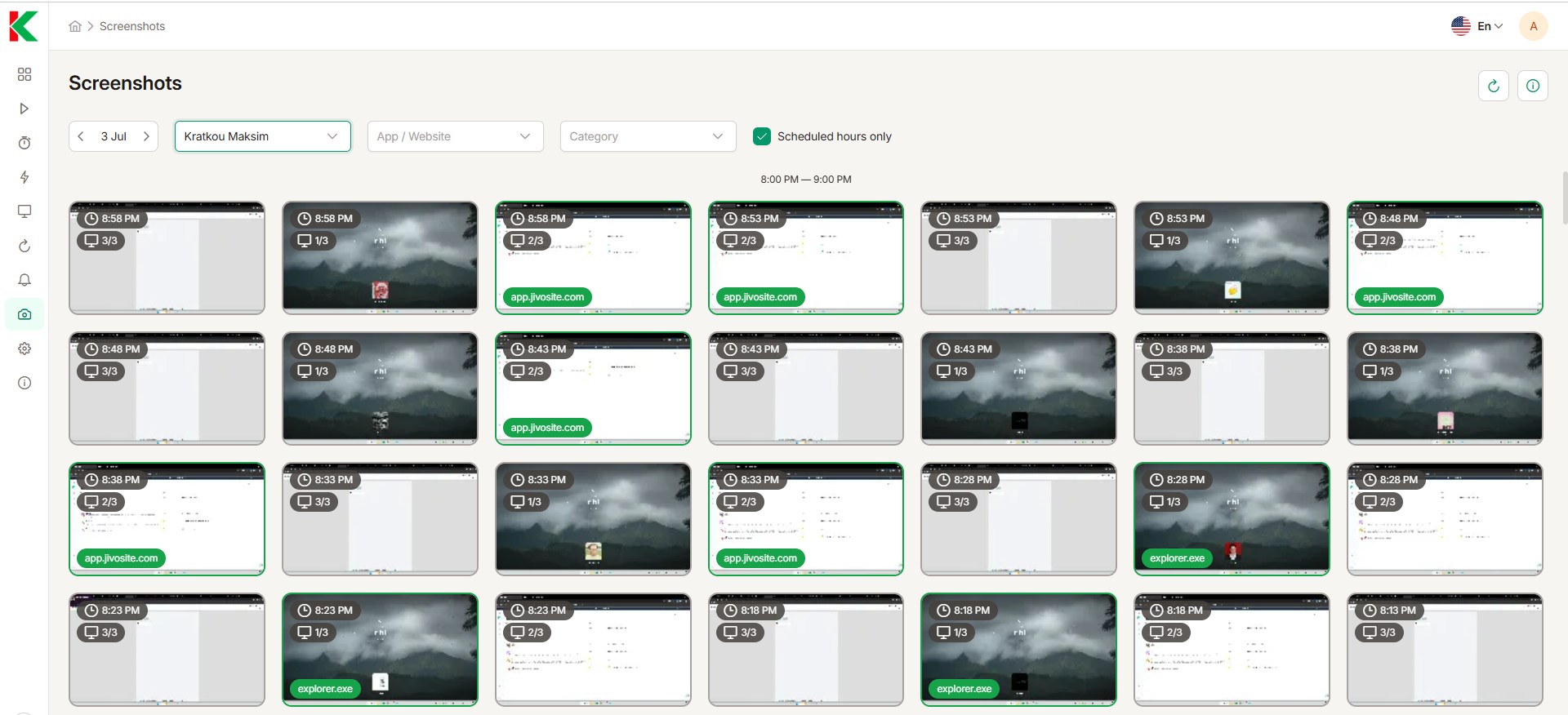
The company may collect work-related data from company systems and devices for timekeeping, security, compliance, system administration, workload analysis, and operational improvement. Depending on the approved tools, data may include login and work times, application and website use, project or task records, and security events.
The company will tell employees what is collected, why it is needed, who can access it, and how long it is retained. Monitoring will be limited to legitimate business purposes and configured to avoid personal accounts, private communications, and off-duty activity wherever practical. Data will not be treated as conclusive proof of performance or misconduct without review and context.
If DLP controls are used, the notice should name them rather than hiding them under the word “security.” Depending on the operating system, KeepActive DLP can record file operations and transfers, clipboard activity, printing, website access, and connected devices, and can block selected actions under policy. Choose only the controls needed for the role; stronger monitoring does not automatically create better security.
Use the company’s ethical employee monitoring policy as a separate, more detailed standard.
12. Review or withdrawal
The company or employee may request a review of the arrangement. Remote work may be changed or withdrawn because of role requirements, performance, security, collaboration needs, legal constraints, or other legitimate business reasons, subject to applicable law and written notice where required.
13. Acknowledgment
I have read this policy, understand the expectations, and agree to follow the policies that apply to my remote work arrangement.
Employee: ____________________ Date: ____________________
Manager/HR: __________________ Date: ____________________
How to customize the template
Separate eligibility from performance
Do not write “remote work is available only to top performers” unless the company can apply that standard consistently. Define role eligibility first, then use ordinary performance management if an approved arrangement is not working.
State the location rule clearly
“Work from anywhere” creates risk when the company means “work from home in the employee’s registered state.” Use plain language about travel, relocation, and cross-border work.
Make availability measurable
Replace “employees must be responsive” with core hours, channels, and reasonable response windows. This reduces anxiety and prevents managers from using online status as a proxy for work.
Explain monitoring before deployment
If the company uses employee monitoring software, the policy should name the data categories, business purposes, access rules, and retention period. Employees should not discover a monitoring tool by accident.
Putting the monitoring clause into practice
A remote-work policy can use KeepActive records from approved company devices to compare schedules with actual work patterns. It should be configured around the written policy, with role-based access and a retention period that matches the stated purpose.
Final review checklist
- Eligibility and approval are clear.
- Work location and travel rules are explicit.
- Nonexempt timekeeping and overtime are addressed.
- Performance is defined through outcomes and quality.
- Security responsibilities are practical.
- Reimbursement language matches local requirements.
- Monitoring is transparent, limited, and reviewable.
- Legal counsel has checked every employee jurisdiction.
- Employees receive the policy before it takes effect.
Make the policy specific enough to use
A policy should settle the questions that otherwise become arguments in chat: who is eligible, where work may happen, when people must be reachable, what the company pays for, and what it can monitor. If managers still make those decisions case by case, the document needs another pass.
