
Schedule adherence measures the percentage of scheduled time an employee spends in the activity planned for that time. It is common in contact centers, service desks, operations teams, and other environments where coverage matters throughout the day.
Use the metric to test whether the staffing plan held during the day. A variance can come from late arrival, an inaccurate schedule, a long customer interaction, a system outage, or reassigned work, so the percentage needs a reason code before it becomes a management judgment.
Schedule adherence formula
Schedule adherence = Time in scheduled activities ÷ Total scheduled time × 100
Suppose an agent is scheduled for 480 minutes, including approved breaks and planned after-call work. If 440 minutes match the schedule:
440 ÷ 480 × 100 = 91.7%
The schedule must identify which activities count as adherent. An approved break is adherent when it occurs in the planned window. A customer call that runs beyond the end of a shift may be productive work but still create a schedule variance.
Choose the measurement grain before calculating the percentage. Daily totals can allow an early deviation and a late deviation to cancel each other out; 15- or 30-minute intervals show the coverage effect but create more noise. Use the interval view for staffing decisions and the daily or weekly pattern for coaching.
Define a tolerance window as well. A few minutes around a break may be operationally harmless in one queue and costly in another. Apply the same tolerance and exception hierarchy to comparable teams, or the adherence percentages will not mean the same thing.
Adherence, conformance, attendance, and occupancy
The related measures answer different questions. Adherence asks whether the employee performed the planned activity at the planned time. Conformance asks whether the total scheduled amount was worked even if the timing changed. Attendance asks whether the employee was present. Occupancy asks what share of available service time was spent handling customer work. Use the term that matches the decision.
An employee can have high conformance but lower adherence by working the full day on a shifted timeline. An agent can have perfect attendance but poor adherence if breaks and work states are consistently mistimed.
What should count as adherent time?
Document the rules for:
- customer interactions;
- approved after-call work;
- scheduled meetings and coaching;
- training;
- approved breaks and meals;
- system downtime;
- schedule changes made by a manager;
- approved offline or back-office work.
Do not count unavoidable system failures against an employee. If a supervisor reassigns work, update the schedule or classify the exception.
What is a good schedule adherence target?
There is no universal benchmark. The right target depends on:
- contact type and average interaction length;
- how precisely activities are scheduled;
- flexibility to move breaks;
- system reliability;
- shrinkage assumptions;
- customer and employee needs;
- whether the metric is calculated by minute, interval, or day.
Build a baseline from your own operation, then test whether the target supports service levels without increasing rushed interactions, skipped breaks, or off-the-clock work.
Why schedule adherence falls
Unrealistic schedules
Schedules may ignore actual handle-time variation, after-call work, meetings, or the time required to switch systems.
Late updates
A manager changes an assignment but the workforce system still compares the employee with the old plan.
Tool friction
Slow applications, repeated logins, or outages consume time that the schedule assumed was available.
Poor break design
Rigid windows can fail when customer interactions naturally run long.
Unclear state rules
Employees may be working but using the wrong status code because definitions or training are weak.
Individual reliability
Repeated late starts, extended breaks, or unapproved activity changes can also reduce adherence. Confirm the pattern after excluding system and planning issues.
A six-step improvement plan
-
Clean the definitions
Publish which states count as adherent and how exceptions are handled.
-
Audit the schedule assumptions
Compare planned activity with actual handle time, after-call work, meetings, and system delays. Fix the plan before coaching people against it.
-
Review intervals, not only daily totals
A daily percentage can hide an uncovered peak. Look at staffing intervals to see where variance affects service.
-
Pair adherence with outcomes
Review first-contact resolution, customer satisfaction, quality scores, and repeat contacts. A higher adherence number is not an improvement if customers have to call again.
-
Coach with specific evidence
Discuss repeated patterns and the operational impact. Ask what prevented the employee from following the schedule and agree on a practical action.
-
Recheck after the change
If the plan, tool, or coaching changed, compare the same intervals over several weeks.
Use work-time data to explain deviations
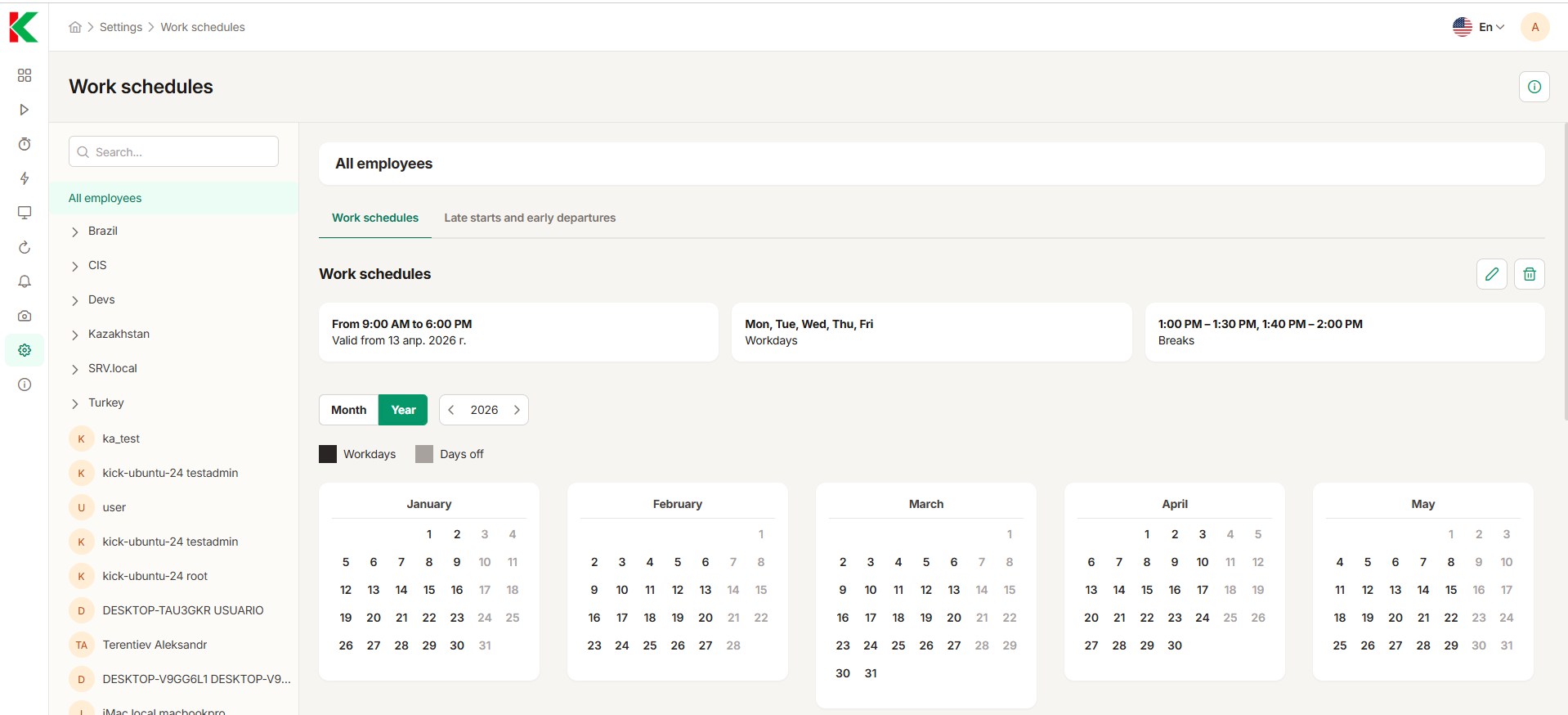
KeepActive work-time reports can show first and last activity, absences, overtime, and work patterns for computer-based teams. Offline activity should be recorded where the role includes calls, meetings, or other work away from the keyboard. KeepActive can add context, but the workforce or contact-center system remains the source for planned states and queue activity.
A simple adherence review table
For each meaningful variance, capture the interval, planned activity, actual activity, reason, whether the employee could control it, and the action. Review recurring causes across several intervals; one isolated variance rarely deserves a process change.
This separates the event from the cause. It also prevents a general coaching conversation from being built on one ambiguous percentage.
Adherence mistakes that encourage bad behavior
- Treating adherence and attendance as the same metric.
- Penalizing approved breaks or schedule changes.
- Ignoring long customer interactions.
- Using a benchmark with a different formula.
- Encouraging employees to skip after-call work.
- Coaching daily noise rather than repeated patterns.
- Improving adherence while quality falls.
- Comparing teams with different schedule precision.
Daily adherence can hide a broken peak interval
A person can finish the day at 92% adherence and still be unavailable during the two intervals that drive the service failure. Aggregate percentages hide timing. Review adherence beside demand and service level by 15- or 30-minute block, then separate late starts, long breaks, unscheduled meetings, system outages, and approved exceptions.
Define a tolerance window before scoring the data. A three-minute state mismatch should not carry the same weight as a missing half-hour at peak. Publish which states count, how short transitions are handled, and when a manager may correct the record. That makes the metric usable for scheduling instead of a source of arguments over noise.
Improve the schedule before policing the variance
Use adherence to find coverage problems, not to grade character. A useful review explains whether the variance came from behavior, bad scheduling, a system failure, or the work itself and then fixes the right cause.
