
Performance reviews are supposed to help people grow. In theory, everyone understands this. In practice, many reviews sound like they were written by a tired HR template generator.
“Meets expectations.”
“Shows initiative.”
“Needs to improve communication.”
“Demonstrates ownership.”
The words are familiar, but the employee often leaves the meeting thinking: “Okay… and what exactly should I do differently?”
That is the real problem with many performance review phrases. They are not wrong. They are just too vague to be useful.
A good performance review should sound like a manager who actually watched the work, understood the context, and can explain what is going well and what needs to change. Not like a legal document. Not like a motivational poster. And definitely not like a random list of corporate adjectives.
This guide gives practical performance review phrases for managers: productivity, quality of work, communication, teamwork, leadership, attendance, remote work, improvement plans, and high performers. Use them as starting points, but adapt them to the person in front of you. The best feedback still sounds human.
The basic idea behind good performance review phrases
A useful performance review phrase usually does three things:
- names the behavior;
- explains why it matters;
- gives a clear next step.
For example, this is weak:
You need to be more proactive.
The employee may understand the criticism emotionally, but not practically. What does “more proactive” mean? Ask more questions? Take more tasks? Warn earlier? Suggest ideas? Make decisions without approval?
A better version:
You often wait for detailed instructions before moving a task forward. Next quarter, I’d like you to suggest at least one possible next step before escalating a blocker.
This is much easier to understand. The person knows what the manager noticed and what should change.
For remote, hybrid, and computer-based teams, performance conversations become stronger when managers combine their own observations with objective patterns from an employee time tracking system. Not to replace judgment with dashboards, but to avoid reviews based only on memory, mood, or whoever spoke the loudest in meetings.
Why wording matters in performance reviews
Performance reviews are emotionally loaded. Even confident employees can feel tense before them. People hear not just “feedback,” but signals about money, trust, career growth, job security, and how their manager really sees them.
That is why wording matters.
If feedback is too vague, the employee gets anxious.
If it is too soft, nothing changes.
If it is too harsh, the person becomes defensive.
If it is too generic, it feels fake.
Good wording does not mean sugarcoating. It means being specific enough to be fair.
Compare these two versions:
Your communication needs improvement.
And:
You usually share updates after a delay has already affected other people. I’d like you to flag risks earlier, even if you don’t have the final answer yet.
The second version may still be uncomfortable, but at least it gives the employee something real to work with.
Performance review phrases for productivity
Productivity feedback is tricky because “productive” does not simply mean “busy.” Someone can answer messages all day and produce very little value. Another person can solve a hard problem in three focused hours.
So when you talk about productivity, focus on outcomes, priorities, consistency, and how the person uses their time.
Positive productivity phrases
- You consistently complete priority tasks on time without needing repeated follow-ups.
- You manage your workload well and usually know which tasks deserve attention first.
- You keep steady output even during busy periods, which makes planning easier for the whole team.
- You are reliable with recurring work, and that consistency reduces pressure on your teammates.
- You use focused work time well and do not get pulled into unnecessary context switching too often.
- You often find practical ways to simplify work without lowering quality.
- You move at a good pace while still paying attention to important details.
- You are good at turning unclear requests into structured next steps.
- You help the team move faster because you do not let small blockers sit for too long.
- You show ownership by following tasks through instead of waiting for constant reminders.
Phrases for improving productivity
- You complete important work, but tasks often take longer than planned. Let’s look at whether the scope is clear enough before you start.
- You sometimes spend too much time on lower-priority tasks while more important work waits.
- Your output is strongest close to deadlines, but we need more consistent progress earlier in the cycle.
- You often switch between tasks, and that seems to slow down deeper work.
- You are putting in effort, but the results are not yet matching the time spent.
- You sometimes wait too long before asking for help, which puts deadlines at risk.
- Your productivity varies a lot from week to week. Let’s identify what helps you work best and what causes the drops.
- You are active during the day, but activity does not always turn into completed work.
- You take on many tasks, but some lose momentum. I’d like you to reduce parallel work and finish fewer things more consistently.
- You need to improve follow-through on tasks that do not have immediate deadlines.
A more natural way to say it
Instead of saying:
Your productivity is inconsistent.
Try:
You have strong weeks and weaker weeks. When priorities are clear, you deliver well. When several tasks compete for attention, your progress becomes more fragmented. Next quarter, let’s work on weekly prioritization and earlier escalation when the workload becomes unclear.
This sounds less like a verdict and more like a real working plan.
Performance review phrases for quality of work
Quality feedback should always be tied to examples. Otherwise, it starts to sound personal.
“Your work is sloppy” is not useful. It makes the person feel attacked.
“The last three reports had missing numbers in the summary section” is much better. It gives the person something concrete to fix.
Positive quality phrases
- Your work is consistently accurate and usually requires very little rework.
- You notice details that other people often miss.
- You think through edge cases before submitting work, which prevents problems later.
- You maintain quality even when deadlines are tight.
- Your documentation is clear and helps others understand the decision-making process.
- You are careful with client-facing work, and that protects the team’s credibility.
- You ask useful clarifying questions before starting complex tasks.
- You take feedback well and apply it in later work.
- You improve the quality of team output by reviewing work thoughtfully.
- You balance speed and accuracy well.
Phrases for improving quality
- Your work sometimes needs additional review because key details are missing.
- You move quickly, but speed sometimes comes at the cost of accuracy.
- You often understand the main task, but smaller requirements get missed.
- Some recent work needed rework because the original request was not fully clarified.
- I’d like you to ask more questions before starting tasks with unclear requirements.
- Your ideas are strong, but the final execution needs more consistency.
- You sometimes rely on others to catch errors that could be prevented with a stronger self-review process.
- Your documentation needs to be clearer so teammates can understand and maintain your work.
- The quality is good when you have enough time, but it drops under pressure.
- You may need to finish fewer tasks at a higher standard rather than pushing too much work through at once.
Performance review phrases for communication
Communication is one of the most common review topics, and also one of the easiest to ruin with vague wording.
“Communicate better” is not feedback. It is a wish.
Good communication feedback should explain what kind of communication is missing: earlier updates, more context, clearer decisions, better documentation, calmer tone, more proactive risk-sharing, or better listening.
Positive communication phrases
- You explain complex topics clearly and make them easier for the team to understand.
- You keep stakeholders informed without overwhelming them with unnecessary detail.
- You are good at summarizing decisions and next steps after meetings.
- You ask clarifying questions early, which prevents confusion later.
- You give timely updates when priorities change.
- You communicate risks before they become urgent.
- You are respectful and direct, even during difficult discussions.
- You adapt your communication style depending on the audience.
- You make remote collaboration easier by writing clear async updates.
- You help reduce confusion by documenting important decisions.
Phrases for improving communication
- You sometimes wait too long to share updates, especially when a task is at risk.
- Your messages can be too brief for complex topics. Please include more context and next steps.
- You often discuss issues verbally, but decisions are not always documented afterward.
- You need to communicate blockers earlier instead of trying to solve everything alone.
- Your updates focus on activity, but stakeholders also need status, risks, and decisions.
- You sometimes assume others have the same context you do.
- During meetings, I’d like you to speak up earlier when you see a problem.
- You provide useful information when asked, but I’d like to see more proactive updates.
- Your feedback can be technically correct but too blunt. Let’s work on making it easier for others to receive.
- You need to close the loop more consistently after a decision is made.
A better version for a difficult review
Instead of:
You are bad at communication.
Say:
The issue is not effort. The issue is timing. You often share updates after a delay has already affected other people. Next quarter, I want you to flag risks earlier, even if the final answer is not ready yet.
This is direct, but it does not attack the person.
Performance review phrases for teamwork
Teamwork is not about being pleasant every minute of the day. It is about helping the team function better.
Some employees are friendly but unreliable. Others are quiet but deeply helpful. Good teamwork feedback should focus on behavior, not personality.
Positive teamwork phrases
- You are generous with your knowledge and help teammates unblock work.
- You support the team without taking over other people’s responsibilities.
- You are reliable during busy periods and help stabilize the team.
- You listen well and make space for other perspectives.
- You collaborate effectively across departments.
- You handle disagreement without making it personal.
- You share context that helps others do their work faster.
- You are willing to step in when the team is under pressure.
- You build trust by doing what you said you would do.
- You help create a calmer, more organized team environment.
Phrases for improving teamwork
- You work well independently, but collaboration sometimes happens too late in the process.
- You sometimes hold important context instead of sharing it early.
- You are strong technically, but teammates may struggle to follow your reasoning without more explanation.
- You sometimes avoid difficult conversations, which lets small issues grow.
- I’d like you to ask for feedback earlier, not only when the work is almost finished.
- You need to be more consistent in following shared team processes.
- You sometimes focus on your own tasks without noticing how delays affect others.
- You can improve by giving teammates more visibility into your progress.
- You are helpful when asked, but I’d like to see more proactive support.
- You need to work on receiving feedback without becoming defensive.
Performance review phrases for leadership
Leadership feedback is not only for managers. Senior specialists, project owners, mentors, and informal leaders need it too.
A person can lead through decisions, calmness, structure, support, expertise, or the ability to bring people back to what matters.
Positive leadership phrases
- You create clarity when the team is dealing with ambiguity.
- You help others stay focused on priorities instead of reacting to every distraction.
- You make decisions calmly and explain the reasoning behind them.
- You take ownership of outcomes, not just tasks.
- You support junior teammates without doing the work for them.
- You raise risks early, even when the conversation is uncomfortable.
- You help the team move from discussion to action.
- You model the behavior you expect from others.
- You handle pressure without spreading panic.
- You make people feel safe to raise problems before they become serious.
Phrases for improving leadership
- You often solve problems yourself instead of developing others to solve them.
- You need to delegate earlier and more clearly.
- You sometimes give direction without enough context, which creates confusion.
- You wait too long to address performance issues.
- You are good at execution, but need to spend more time on planning and prioritization.
- You sometimes avoid making decisions when the team needs direction.
- You need to give more specific feedback instead of general comments.
- You should create more visibility around goals, risks, and ownership.
- You sometimes step in too quickly, which reduces autonomy for the team.
- You need to protect the team’s focus time more actively.
Performance review phrases for attendance and reliability
Attendance feedback should be factual. This is not the place for moral judgments.
Do not say:
You clearly do not care about work.
Say:
There were several late starts this quarter, and they affected team coverage.
Reliability is about patterns and impact. If someone is occasionally late because life happens, that is one conversation. If late starts, early departures, missed updates, and unpredictable availability become a pattern, that is another.
Positive attendance and reliability phrases
- You are consistently reliable with your schedule and availability.
- You communicate schedule changes early, which helps the team plan.
- You are dependable during critical work periods.
- You follow attendance rules without needing reminders.
- You manage breaks and working time responsibly.
- You are transparent when unexpected issues affect your availability.
- You maintain a stable work rhythm that makes collaboration easier.
- You are usually available when the team depends on you.
- You plan ahead when you need time off.
- You help managers avoid last-minute coverage problems.
Phrases for improving attendance and reliability
- There were several late starts this quarter, and they affected team planning.
- You sometimes notify the team about schedule changes too late.
- Your availability has become less predictable, which makes collaboration harder.
- You need to follow the agreed schedule more consistently.
- Early departures have increased recently, and we need to understand whether this is a workload, scheduling, or personal issue.
- You are completing tasks, but your work rhythm is difficult for others to plan around.
- I’d like you to communicate delays before the workday starts whenever possible.
- Attendance issues are becoming a pattern, so we need a clear improvement plan.
- You need to update your status more consistently when your availability changes.
- Let’s review whether your current schedule still fits the role and team needs.
If attendance keeps coming up in reviews, managers should stop relying on memory. A structured time and attendance tracking setup helps separate facts from frustration: late starts, early departures, absences, work schedules, and actual activity patterns.
Performance review phrases for remote and hybrid employees
Remote performance reviews need extra care because visibility can be misleading.
A quiet remote employee may be doing excellent deep work. A very visible employee may simply be sending more messages.
The manager’s job is not to reward whoever looks busiest online. The job is to understand output, communication, reliability, and how well the person works inside a distributed team.
Positive remote work phrases
- You communicate clearly in async channels and help reduce unnecessary meetings.
- You manage your time well without needing constant check-ins.
- You keep your work visible through useful updates and documentation.
- You are reliable across time zones and respect other people’s working hours.
- You use focused work time effectively and protect your attention from distractions.
- You respond well to remote collaboration challenges.
- You make decisions easier by documenting context and next steps.
- You maintain strong output without needing office-based supervision.
- You help the team stay aligned even when people are not online at the same time.
- You balance independence with timely communication.
Phrases for improving remote work
- You complete work, but your progress is not always visible to the team.
- You sometimes go quiet when a task is blocked, which delays support.
- Your async updates need more context so others can understand status without extra questions.
- You are available online, but priority tasks do not always move forward consistently.
- You need to communicate schedule changes more clearly in advance.
- Your workday appears fragmented, and we should review whether meetings or interruptions are affecting focus.
- You sometimes rely too much on live calls instead of documenting decisions.
- You should update task status more consistently so the team can plan around your work.
- You need to create clearer boundaries between focus time and communication time.
- Let’s review your remote work rhythm and identify what helps you stay focused.
For distributed teams, online monitoring can help managers understand work patterns without asking for constant manual updates. The point is not to catch people. The point is to avoid guessing.
Performance review phrases for improvement plans
Sometimes a review needs to be direct. Soft wording can become unfair if the employee does not understand the seriousness of the situation.
A good improvement phrase should be clear, specific, and measurable. It should not sound like a threat, but it also should not hide the problem.
Direct but fair phrases
- Your current performance is below the expectations for this role, especially in meeting deadlines and communicating risks.
- The main issue is not effort, but consistency. We need to see more predictable delivery over the next review period.
- Several tasks required repeated follow-up, and that created additional work for the team.
- The same feedback has come up in multiple review cycles, so we need to treat this as a priority improvement area.
- Your work quality improves after feedback, but the first version often misses key requirements.
- We need to see visible progress in this area within the next 30 to 60 days.
- We will define clear expectations, checkpoints, and success criteria so there is no ambiguity.
- I want to support your improvement, but the current pattern cannot continue.
- Let’s agree on what “good” looks like and how we will measure progress.
- If these expectations are not met, we will need to discuss next steps.
A better version of a hard message
Instead of:
You are not performing well.
Say:
Your performance is currently below expectations in two areas: deadline reliability and early communication of blockers. Over the next 60 days, I need to see priority tasks delivered on agreed dates, or risks communicated at least 48 hours before the deadline. We will review progress every two weeks.
This is not soft, but it is fair. The employee understands the issue, the timeline, and the standard.
Performance review phrases for high performers
High performers need good feedback too. In many companies, they get the laziest feedback because managers assume everything is fine.
“Great job, keep it up” is pleasant, but it does not help a strong person grow.
High performers need recognition, challenge, career direction, and sometimes protection from becoming the team’s emergency resource for everything.
Positive phrases for high performers
- You consistently deliver high-quality work and raise the standard for the team.
- You take ownership of complex problems and move them forward without close supervision.
- Your judgment is strong, especially when priorities are unclear.
- You are trusted by teammates because you follow through on difficult commitments.
- You improve not only your own work, but the process around the work.
- You handle ambiguity well and create structure where others may feel stuck.
- You are one of the people the team relies on during high-pressure periods.
- Your work has a visible impact beyond your direct responsibilities.
- You combine speed, quality, and clear communication.
- You are ready for more strategic ownership if you want to move in that direction.
Growth phrases for high performers
- Your next growth area is delegation. You are strong individually, but you can create more impact by developing others.
- You often become the default person for urgent work. We need to protect your focus and avoid overload.
- You are ready to take more ownership of cross-functional decisions.
- I’d like you to become more visible as a mentor for junior teammates.
- Your work is strong, and the next step is influencing the system around the work.
- You can increase your impact by documenting your approach so others can learn from it.
- You should spend less time rescuing tasks and more time preventing the same problems from repeating.
- Your next challenge is moving from execution leadership to strategic leadership.
High performers often burn out because they are reliable. Managers should watch this carefully. A tool like KeepActive 2.0 can help notice patterns such as long active days, increasing after-hours work, fragmented focus time, or rising workload before the employee openly says, “I’m exhausted.”
How KeepActive 2.0 can support fair performance reviews
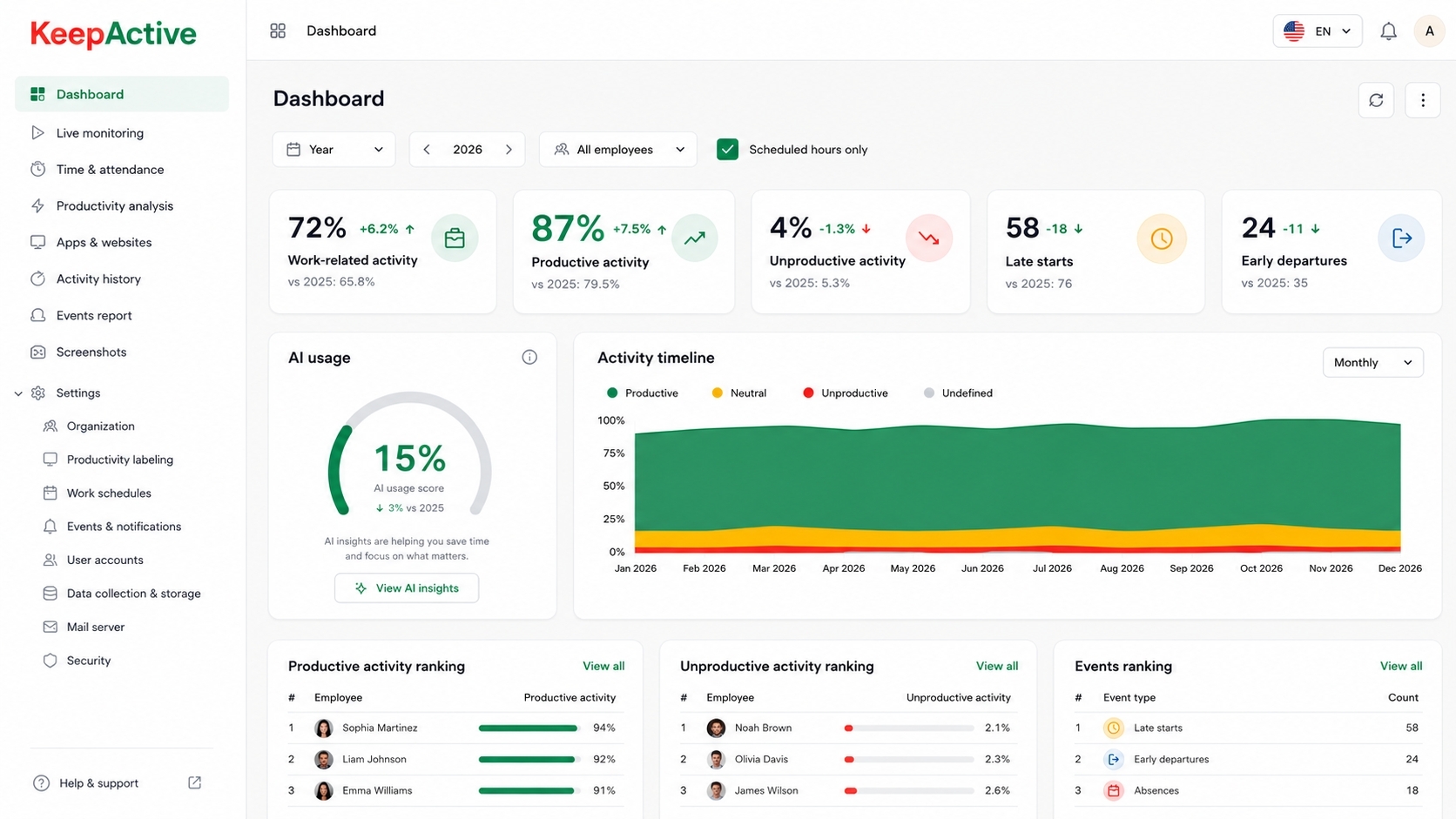
Performance reviews should never be based only on software data. A dashboard does not understand difficult clients, unclear requirements, emotional labor, creative thinking, or the invisible work of preventing problems before they happen.
But data can still make reviews fairer when managers use it carefully.
KeepActive 2.0 can help managers see work patterns over time: schedules, late starts, early departures, activity levels, productive and unproductive activity, apps and websites, screenshots, and changes in work rhythm.
This is useful because many performance issues are patterns, not isolated moments.
For example:
- productivity drops after a schedule change;
- late starts increase after several weeks of overtime;
- focus time gets fragmented by meetings;
- one department has higher idle time than others;
- a high performer is active too late too often;
- a remote employee’s output drops because priorities are unclear, not because they are lazy.
Used badly, this data becomes micromanagement.
Bad:
Your productive activity was lower on Wednesday. Explain.
Better:
I noticed your work rhythm changed over the last month. There are fewer long focus periods and more interruptions. Is this workload, meetings, unclear priorities, or something else?
The data should open a better conversation. It should not replace the conversation.
Performance review phrases by rating
Some companies use rating scales. These phrases can help managers write reviews without sounding too mechanical.
Exceeds expectations
- You consistently deliver beyond the expectations of your role.
- Your work has a measurable positive impact on the team’s results.
- You take ownership of complex problems and improve the way the team works.
- You are trusted to handle important work with minimal supervision.
- You raise the standard for quality, communication, and follow-through.
Meets expectations
- You reliably meet the core expectations of your role.
- You complete assigned work on time and communicate when support is needed.
- You collaborate effectively with teammates and follow agreed processes.
- Your performance is stable and dependable.
- You contribute positively to team goals.
Needs improvement
- Your performance is inconsistent, especially in deadline reliability and communication.
- You need to take more ownership of tasks from start to finish.
- Your work sometimes requires avoidable rework.
- You should communicate blockers earlier and ask for clarification sooner.
- We need to see more consistent progress in the next review period.
Unsatisfactory
- Your current performance is below the minimum expectations for this role.
- The same issues have continued despite previous feedback.
- Missed deadlines and unclear communication are affecting the team’s work.
- Immediate improvement is required in the areas we have outlined.
- We will set specific expectations and review progress within a defined timeline.
Common mistakes managers make in performance reviews
Being too vague
“Be more proactive” sounds normal, but it does not explain what should change. Give examples.
Saving feedback for review day
A performance review should not be the first time an employee hears important criticism. If something matters, talk about it earlier.
Criticizing personality instead of behavior
Do not say “you are careless.” Say “the last three reports had errors that could have been caught with a final review.”
Giving generic praise
“Great team player” means little unless you explain what the person did and why it helped.
Using data without context
Time, activity, and attendance data can support a review, but they should not become the whole review.
Avoiding difficult feedback
Being kind does not mean being unclear. Employees deserve to know where they stand.
Final thoughts
Performance review phrases are not magic. A lazy manager can use polished language and still give a useless review. A good manager can use simple words and make the conversation valuable.
The goal is not to sound impressive. The goal is to be clear, fair, specific, and human.
Employees need to understand what they are doing well, where they need to improve, why it matters, and what happens next. Managers need language that is direct without being cruel, supportive without being vague, and practical without sounding robotic.
The best performance reviews do not feel like a court verdict. They feel like a serious conversation between adults.
If the employee leaves the review understanding what to continue, what to change, and how success will be measured, the review was worth having.
