
Low output is often blamed on motivation before anyone checks the system around the employee. In practice, unclear priorities, overloaded queues, missing skills, unreliable tools, and weak management can waste more capacity than individual effort.
Take one recent piece of work and compare its result, quality, elapsed time, touch time, dependencies, and rework. That evidence separates a performance issue from a workflow that makes competent people look unproductive.
Signs of low productivity at work
Look for a pattern across output, quality, time, and customer impact rather than one isolated metric.
Read the pattern before choosing the fix. Slipping deadlines point first to workload, dependencies, and scope changes. Rising rework points to requirements, training, handoffs, or review standards. Longer cycle time often means work is waiting between steps. Persistent overtime suggests a demand or staffing mismatch. Large differences between teams can implicate the system or manager. High activity with flat results usually means effort is going to low-value work, meetings, or duplicate entry.
Use at least one result metric and one diagnostic metric. For a support team, that could mean resolved cases and reopen rate, supported by queue time and scheduled coverage. For a software team, it might mean completed, accepted work and escaped defects, supported by blocked time and review latency.
12 common causes of low employee productivity
1. Unclear priorities
When everything is urgent, employees make local decisions about what matters. Work starts, stops, and restarts; important tasks wait behind visible but lower-value requests.
Fix: Give each team a short ranked list of outcomes. Name the person who can change the order and require new urgent work to displace something already planned.
2. Workload exceeds available capacity
An overloaded team spends more time switching, coordinating, and recovering from mistakes. Adding work can reduce total throughput when every assignment remains open at once.
Fix: Compare committed work with practical capacity, including meetings, support duties, leave, and normal variability. Limit work in progress and renegotiate scope before deadlines fail.
3. Role ambiguity
Tasks are duplicated when ownership is unclear, while other tasks fall between departments. Employees may also spend time on work below or outside their role because no one else owns it.
Fix: Define one accountable owner for each recurring output. A lightweight RACI table can clarify who is responsible, accountable, consulted, and informed without turning every decision into a committee.
4. Weak management systems
Managers affect productivity through planning, feedback, staffing, escalation, and decision speed. A team cannot compensate indefinitely for changing instructions or slow approvals.
Fix: Review the operating cadence: weekly priorities, one-on-ones, escalation rules, decision rights, and progress reviews. Coach managers on observable practices, not personality.
5. Insufficient training
Employees lose time searching for answers, repeating avoidable errors, or waiting for a knowledgeable coworker. Training gaps are especially costly after a process or software change.
Fix: Separate knowledge gaps from experience gaps. Provide short role-based instruction, examples of acceptable work, a searchable source of truth, and practice with feedback.
6. Poor process design
Extra approvals, manual copying, unclear intake, and repeated status updates can consume more time than the work itself.
Fix: Map one high-volume workflow from request to accepted output. Measure touch time and wait time. Remove steps that do not reduce risk, improve quality, or satisfy a real requirement.
7. Tool friction and application sprawl
Employees lose productive time when systems are slow, unreliable, or poorly integrated. Multiple tools may hold competing versions of the same customer, project, or task data.
Fix: Identify the system of record for each type of information. Track duplicate entry, common failure points, unused licenses, and applications that create work rather than remove it. Website usage tracking can show where the stack deserves a closer look, but adoption data should be interpreted with employee context.
8. Too many interruptions
Meetings, alerts, chat messages, and unscheduled requests fragment attention. The cost is not only the interruption; employees must reconstruct the context of complex work afterward.
Fix: Establish focus blocks, office hours, channel rules, and a clear definition of an emergency. Cancel recurring meetings that have no decision, coordination, or learning purpose.
9. Misaligned goals and incentives
People adapt to what the organization rewards. A speed target can damage quality. A utilization target can encourage unnecessary hours. An individual quota can discourage collaboration.
Fix: Pair output with quality and customer measures. Review incentives for predictable gaming and explain which tradeoffs employees should make when goals conflict.
10. Burnout, fatigue, or unsustainable schedules
Long hours may lift short-term output while increasing errors, absence, and turnover risk. Workload, staffing, schedule control, and recovery time are management variables, not merely personal resilience issues.
Fix: Review sustained overtime, after-hours work, unused leave, schedule changes, and workload concentration. Reduce the source of overload before offering another wellness benefit.
11. Low psychological safety
Employees hide risks and errors when raising a concern brings blame. Problems reach managers late, when the cost of correction is higher.
Fix: Ask for bad news early, distinguish a reasonable mistake from negligence, and make post-project reviews about the system as well as individual decisions.
12. A real performance problem
Sometimes expectations are clear, resources are adequate, and comparable employees succeed, but one person repeatedly does not meet the standard.
Fix: State the gap with specific examples, confirm the employee understands the standard, ask about barriers, agree on support and a review date, and document the conversation. Follow company policy and applicable employment law.
How to diagnose the real cause
Start with a unit of work
Choose a customer case, invoice, report, design, shipment, or other meaningful output. Define when work starts and when it is accepted. “Emails sent” or “hours online” are activity counts, not completed units.
Segment the pattern
Compare periods, teams, work types, customer groups, and process stages. A company-wide decline suggests a different cause from a problem isolated to one workflow or manager.
Separate touch time from wait time
If a task takes 40 minutes of active work but six days to complete, pushing the employee to type faster will not solve the problem. Find the queue, dependency, or approval that owns the delay.
Ask employees before drawing conclusions
The people doing the work often know which system fails, which report is duplicated, or which approval adds no value. Validate those observations with data rather than treating either source as complete on its own.
Run a bounded experiment
Change one constraint for two to four weeks: reduce work in progress, clarify intake, remove a meeting, add training, or rebalance a queue. Compare the same outcome and quality measures before and after.
What activity data can clarify
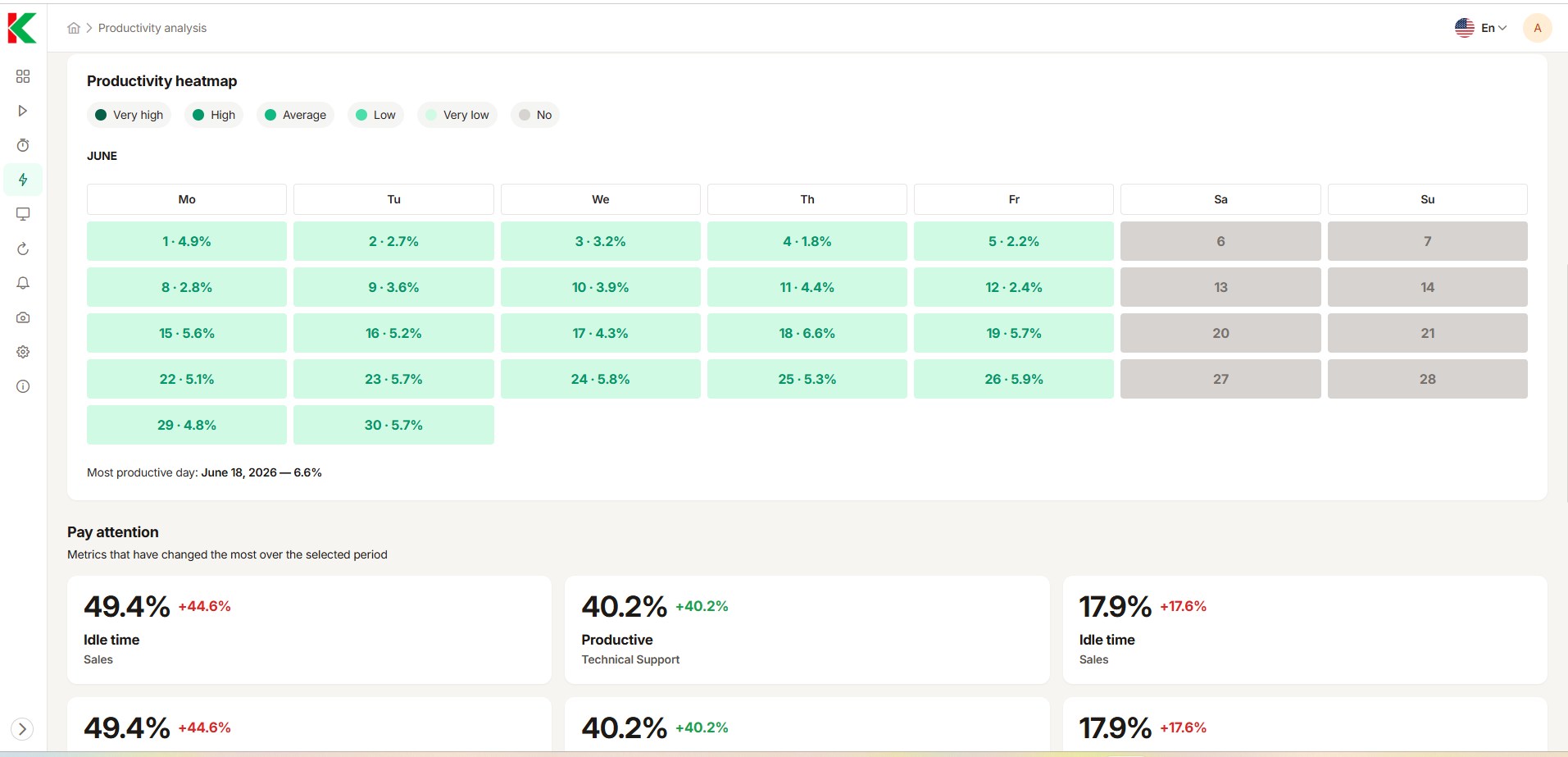
KeepActive can add context for computer-based teams by showing work time and the applications and websites used on approved devices. That can help a manager investigate tool friction, workload patterns, or excessive switching. It should not be used as a universal productivity score: application activity does not prove quality, value, or intent. Combine it with business outcomes, employee explanation, and a transparent monitoring policy.
What not to do
- Do not rank employees by mouse movement, keystrokes, or online status.
- Do not launch a tool before defining the question it should answer.
- Do not compare roles that produce different kinds of value.
- Do not reward raw output without checking quality and customer impact.
- Do not treat a temporary dip during onboarding, reorganization, or system migration as a stable trait.
- Do not make a disciplinary decision from one dashboard without review and context.
Diagnose the constraint before escalating pressure
Start with a piece of work that was late, costly, or poor and follow it through the system. That usually reveals more than a general conversation about motivation, and it gives the manager something concrete to fix.
